Entertainment venue IT support
Family entertainment centres run arcade cards, go-kart timing, bowling scoring, laser tag, POS, payments, staff devices, and guest WiFi on overlapping infrastructure. Treo supports the shared layer so vendor systems can coexist without recurring conflicts.
A typical family entertainment centre has separate vendors for arcade cards, go-kart timing, bowling lanes, laser tag, POS, payments, guest WiFi, phones, and cameras. Each vendor knows its own platform, but none of them owns the network, wireless design, segmentation, or capacity planning that all of those platforms share.
The friction appears when those systems are installed, changed, or supported in isolation. A POS wireless change can interfere with card readers. Guest WiFi can compete with attraction systems. Payment processing can share too much with operational traffic. Treo fills the infrastructure ownership gap between vendors.
The scope depends on the venue, attraction mix, and vendor landscape. The support pattern stays the same: keep the shared infrastructure stable enough for every system using it.
| Workstream | What it covers | Why it matters |
|---|---|---|
| Arcade and redemption systems | Intercard and Embed cashless card systems, reader connectivity, game controllers, prize management, redemption stations, and floor network requirements. | Arcade revenue depends on card readers, games, and redemption systems staying connected across a noisy public venue floor. |
| Go-kart timing and race systems | Apex Timing support, timing hardware, sensor connectivity, results displays, leaderboard systems, and real-time network reliability. | Race timing cannot tolerate spotty connectivity during live heats, especially when guests are watching results in real time. |
| Bowling and lane systems | Brunswick scoring, lane control, scoring displays, reservations, league systems, and the infrastructure tying lanes to front-desk operations. | Lane systems touch bookings, scoring, guest flow, and league operations, so vendor support needs the venue network context. |
| Laser tag and attraction control | Delta Strike and similar attraction systems, arena networking, vest communication, scoring, displays, and session management. | Attraction downtime is visible to guests immediately and often sits between vendor equipment, wireless design, and local infrastructure. |
| POS, food service, and payments | Touch Bistro POS, kitchen displays, order routing, payment connectivity, card processing isolation, and PCI-aware segmentation. | Food service and payment systems need to keep revenue moving without sharing risk or congestion with guest and attraction traffic. |
| Network, WiFi, and vendor coordination | VLAN segmentation, guest WiFi isolation, vendor WiFi coordination, remote access paths, monitoring, channel planning, and peak-hours capacity. | The shared infrastructure is where most cross-vendor problems live, and it needs one owner instead of a collection of vendor assumptions. |
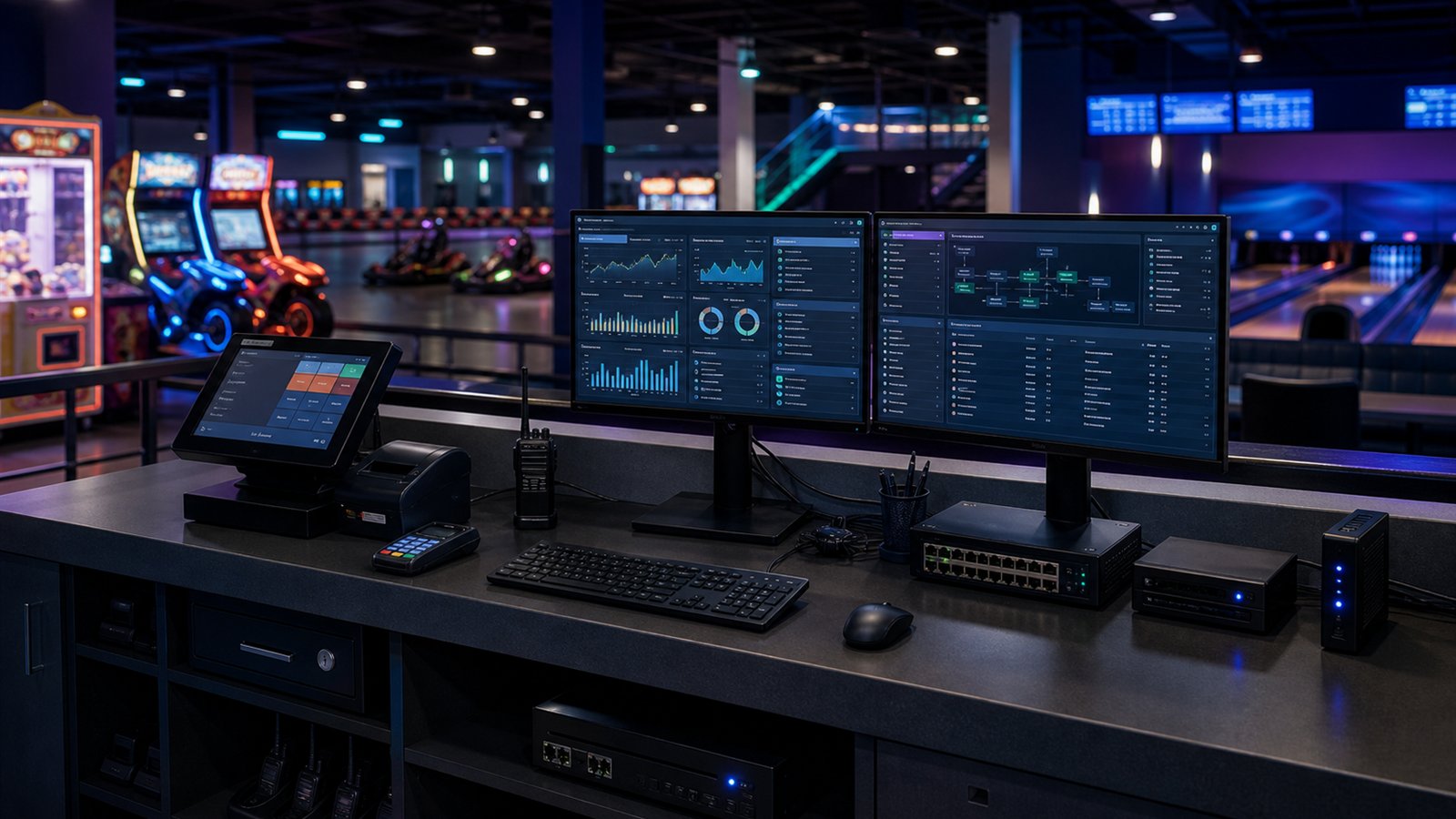
Entertainment venue support is valuable when it manages the shared infrastructure layer first, then coordinates vendor systems around that foundation without disrupting guest-facing operations.
The starting point is knowing which systems share infrastructure, where vendor requirements collide, and which services are revenue-critical during peak hours.
Segmentation reduces interference, supports PCI obligations, limits blast radius, and gives each system a cleaner operating path.
WiFi requirements, remote support access, updates, cabling, and diagnostics are coordinated so each vendor gets what it needs without undermining the others.
Friday nights, weekends, birthday parties, and seasonal peaks set the standard. Infrastructure that survives only quiet hours is not ready for the venue.
Support expectations and escalation paths need to reflect the fact that attractions, payments, WiFi, and POS failures affect guests and revenue in real time.
Each vendor may be competent inside its own product. The venue still needs one infrastructure view that explains how those systems should coexist.
| Area | Vendor assumption | Venue reality |
|---|---|---|
| Ownership | Each vendor supports its own system. | The failure often lives between systems, wireless coverage, switch configuration, cabling, permissions, or capacity. |
| Wireless | Every vendor can bring or request whatever WiFi setup its system prefers. | Arcade readers, POS, guest WiFi, staff devices, and attraction controllers compete in the same physical airspace. |
| Peak load | Testing during quiet hours proves the system works. | The venue earns during rushes, parties, weekends, and seasonal spikes, which is when design weaknesses appear. |
| Security | Guest access, vendor access, and operations traffic can share a convenient network. | Payments, attraction systems, vendor support paths, and public WiFi need deliberate separation and monitoring. |
These are the questions we hear most often from venue operators evaluating whether they need a support partner with multi-attraction and multi-vendor context.
Treo supports Intercard and Embed cashless card platforms and the infrastructure they depend on. That includes game controller connectivity, prize management, card reader reliability, and the network requirements that keep these systems running across the venue floor.
Treo resolves WiFi conflicts between vendor systems by assessing competing wireless requirements, channel use, access point placement, and segmentation. The goal is a managed wireless environment that serves attraction systems, POS, staff devices, and guest access without uncoordinated interference.
Treo plans entertainment venue support around peak periods such as Friday-night rushes, weekend peaks, birthday party surges, and seasonal demand. Infrastructure that works only during quiet hours is not reliable enough for a venue, so capacity and support planning focus on the busiest windows.
Entertainment venue IT work usually sits alongside a broader managed IT relationship, where Treo handles both the attraction systems and the surrounding environment, including office staff support, Microsoft 365, security, and general infrastructure.
A short conversation can clarify where vendor conflicts, WiFi congestion, segmentation gaps, payment reliability, or peak-hour capacity may be creating risk, and whether Treo is the right fit for your entertainment environment.