Medical clinic IT support

Keep EMR, imaging, and patient data moving.

Treo supports the infrastructure behind medical clinics: EMR/EHR environments, Carestream imaging workflows, Safecom secure printing, backups, network reliability, and PIPEDA/PIPA controls.

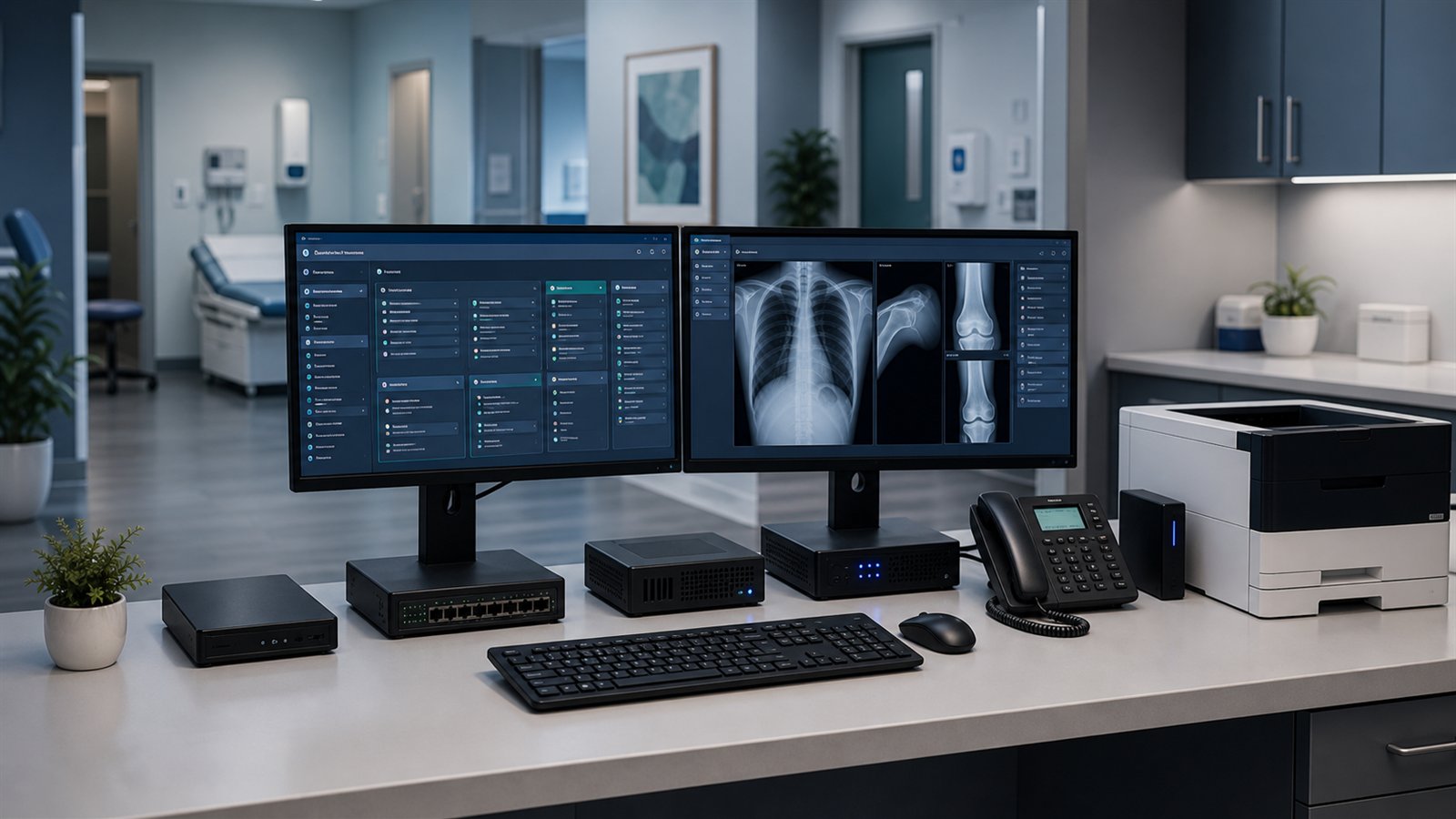
Medical clinic workstation with EMR screens, diagnostic imaging review, secure printer, and network hardware
EMR workflow Imaging review Secure output
EMR/EHR environment Workstations, servers, backups, access, and integrations
Clinical systems Carestream imaging, DICOM workflow, peripherals, and output
Patient data PIPEDA, PIPA, Safecom, recovery, and breach readiness
Where support gets complicated

The technology problem is usually the handoff between systems.

Medical clinics depend on more than a single clinical application. EMR/EHR systems handle scheduling, patient records, billing, and clinical documentation. Imaging systems capture and store diagnostic data. Secure printing, telehealth, clinical peripherals, Microsoft 365, backup systems, and network infrastructure all sit around that workflow.

Friction appears when those pieces are bought, upgraded, or supported in isolation. The clinic needs someone who understands the operating environment, protects patient information, and coordinates the support path when the issue crosses vendor boundaries.

EMR/EHR Infrastructure, workstations, access, backup, and data flow
Carestream Imaging workflow, storage, retrieval, and clinical review
Safecom Secure printing and access-aware output controls
Compliance PIPEDA, PIPA, breach readiness, and documentation
Coverage

What Treo handles in medical clinic environments

The scope depends on the clinic, but the work usually falls into the systems that keep care, privacy, and daily operations connected.

Workstream What it covers Why it matters
EMR/EHR environment Servers, workstations, access, updates, backups, data flow, and the infrastructure around the clinic's electronic medical records platform. The EMR sits at the center of scheduling, documentation, billing, and patient records. If the surrounding environment is fragile, the clinic feels it everywhere.
Diagnostic imaging workflow Carestream support, DICOM workflow, image storage, retrieval, archival reliability, and handoffs between imaging and EMR systems. Diagnostic images need to move cleanly from capture to review without staff building manual workarounds or losing clinical context.
Patient data protection PIPEDA and PIPA alignment, access controls, encryption, breach response planning, recovery coverage, and compliance documentation. Medical clinics handle protected health information. Privacy controls need to be operational, documented, and recoverable under pressure.
Secure printing and output Safecom secure printing, printer access controls, queue reliability, output routing, and support for patient-facing paperwork. Printed output can expose patient information if release controls, device reliability, and clinic workflows are not managed together.
Clinic network and infrastructure Wired and wireless networks, firewalls, segmentation, monitoring, clinical peripherals, telehealth reliability, and workstation support. Exam rooms, reception, imaging, telehealth, and administration all depend on infrastructure that cannot be treated as generic office IT.
Vendor coordination and continuity Coordination across EMR, imaging, telehealth, ISP, phones, printers, and cloud vendors, plus backup testing and continuity planning. The clinic should not be left translating between vendors when downtime, data flow, or recovery risk crosses system boundaries.
How the work moves

Support has to respect clinical workflow and privacy obligations.

Medical clinic IT support is valuable when it follows the real order of operations: protect patient data, stabilize core systems, connect the workflow, coordinate vendors, and keep care moving during support work.

Assess

Map the clinic's systems, workflows, vendors, and compliance posture.

EMR/EHR environment, imaging, network infrastructure, Safecom printing, backup coverage, patient data handling, and vendor ownership are reviewed before recommendations are made.

Secure

Address patient data protection and recovery gaps early.

Access controls, encryption, secure printing, backup coverage, recovery testing, and breach response planning are treated as operational requirements, not cleanup after a project.

Connect

Make sure EMR, imaging, and supporting clinical systems work together.

Data should move between the EMR, Carestream imaging, diagnostic equipment, telehealth platforms, and cloud tools without unreliable manual workarounds.

Coordinate

Reduce vendor confusion and establish clear support paths.

When a problem crosses EMR, imaging, printer, phone, ISP, or cloud boundaries, Treo coordinates the technical path instead of leaving the clinic in the middle.

Support

Provide ongoing support that reflects how a medical clinic operates.

Clinic schedules are demanding, patient care comes first, and support work needs to account for reception, exam rooms, imaging, administration, and after-hours continuity.

Why it is different

Office IT assumptions do not hold up cleanly inside a clinic.

The office still matters, but medical clinics add clinical systems, regulated data, and workflow dependencies that change the support model.

Area Office IT assumption Clinic reality
Workflow A workstation issue slows one employee. A workstation or network issue can slow check-in, chart access, imaging review, prescriptions, billing, and patient flow.
Data Files and email are the main information risk. Protected health information lives across EMR, imaging, print queues, backups, exports, devices, and vendor systems.
Vendors Each software vendor can support its own product independently. Clinic problems often sit between EMR, imaging, network, printing, telehealth, and internet providers.
Recovery Backups matter mainly for files and servers. Recoverability needs to cover records, imaging, configuration, access, and the order required to resume clinic operations.
Common questions

Questions medical clinics ask before changing IT support

These are the questions we hear most often from medical clinics evaluating whether they need a different kind of IT support.

Do you support our EMR/EHR system?

Treo supports the infrastructure and integrations around the clinic's EMR, not the EMR application itself. That means the servers, workstations, network, data flow, and backup coverage that keep the EMR running reliably and connected to the rest of the clinic environment.

How do you handle PIPEDA and PIPA compliance?

Treo helps medical clinics meet PIPEDA and PIPA obligations through access controls, encryption, backup coverage, secure printing via Safecom, and breach response planning. Compliance is treated as an ongoing operational requirement, not a one-time project.

What if we are considering upgrading or replacing a clinical system?

Treo can help evaluate compatibility, integration requirements, and infrastructure readiness before a purchase. The goal is to make sure a new system fits the clinic's environment and workflows before it creates disruption.

How does this connect to managed IT?

Medical clinic IT work usually sits alongside a broader managed IT relationship, where Treo handles both the clinical systems and the surrounding environment, including Microsoft 365, security, user support, and general infrastructure.

Need clearer support for the systems behind your clinic?

A short conversation can clarify where EMR workflows, imaging, secure printing, compliance, or vendor coordination may be creating friction, and whether Treo is the right fit for your clinic.

Talk to an Expert